



A wall is rarely experienced on its own. There is the floor beneath it, the furniture drawn up beside it and the light that reaches it at different hours. In a home, a material becomes part of all these relationships.
Microcement has a particular presence within an interior. Its continuous surface can connect one part of a room to another, while subtle variations in the finish give the eye something to return to. The effect depends on the colour, the texture, the light and the materials that share the space.
If you are planning a renovation and considering microcement for your home’s interior, the right finish will depend on what you want to change. Would you like to give a familiar room a cleaner, more contemporary look? Or bring a greater sense of continuity to the space?
These questions guide how the DreamR team designs a home with microcement, from the first sample to the finished surface.
BRINGING MICROCEMENT INTO AN INTERIOR
The character of a microcement finish depends in part on the materials around it. Metal can give its softly varied surface a more defined edge, while natural stone can introduce a different pattern and depth. The balance begins with the kind of interior the homeowner wants to create.
For the owners of a Good Class Bungalow we renovated, the wish was for a more contemporary home that still retained the material quality and craftsmanship they valued. We brought microcement together with metal accents and natural marble: the microcement gave the interior a pared-back foundation, while the metal and stone introduced definition and richness.
In the children’s bathroom, this approach creates an intimate, restful space. Warm-toned microcement wraps around the freestanding bath, giving the walls continuity and subtle variation. The bath’s smooth white form stands out against it, while the glass partition keeps the finish visible through the shower area. Together, they give the room a contemporary character without losing its warmth.

Your home may call for a different balance. There may be a material you want to keep, or a room you would like to feel less formal. We look at where microcement could be used and how it would sit alongside the other finishes, so the combination supports what you want the space to become.
CHOOSING A MICROCEMENT COLOUR FOR YOUR INTERIOR
Microcement can be made in shades ranging from sand and beige to grey. The colour is selected with the room’s other materials in mind, since they can change how its undertones appear.
A warm grey beside oak may take on an almost beige cast. The same grey beside a pale stone may appear cooler. The microcement itself has not changed, but the material beside it can make different undertones more noticeable.
The material bar at the House gives us a place to work through those relationships with you. We lay out the finishes proposed for your home and compare microcement shades alongside them. You can handle the samples, see them together and notice how a change in shade affects the palette. One grey may draw out the warmth of a timber; another may give a stone’s colour or veining greater definition.
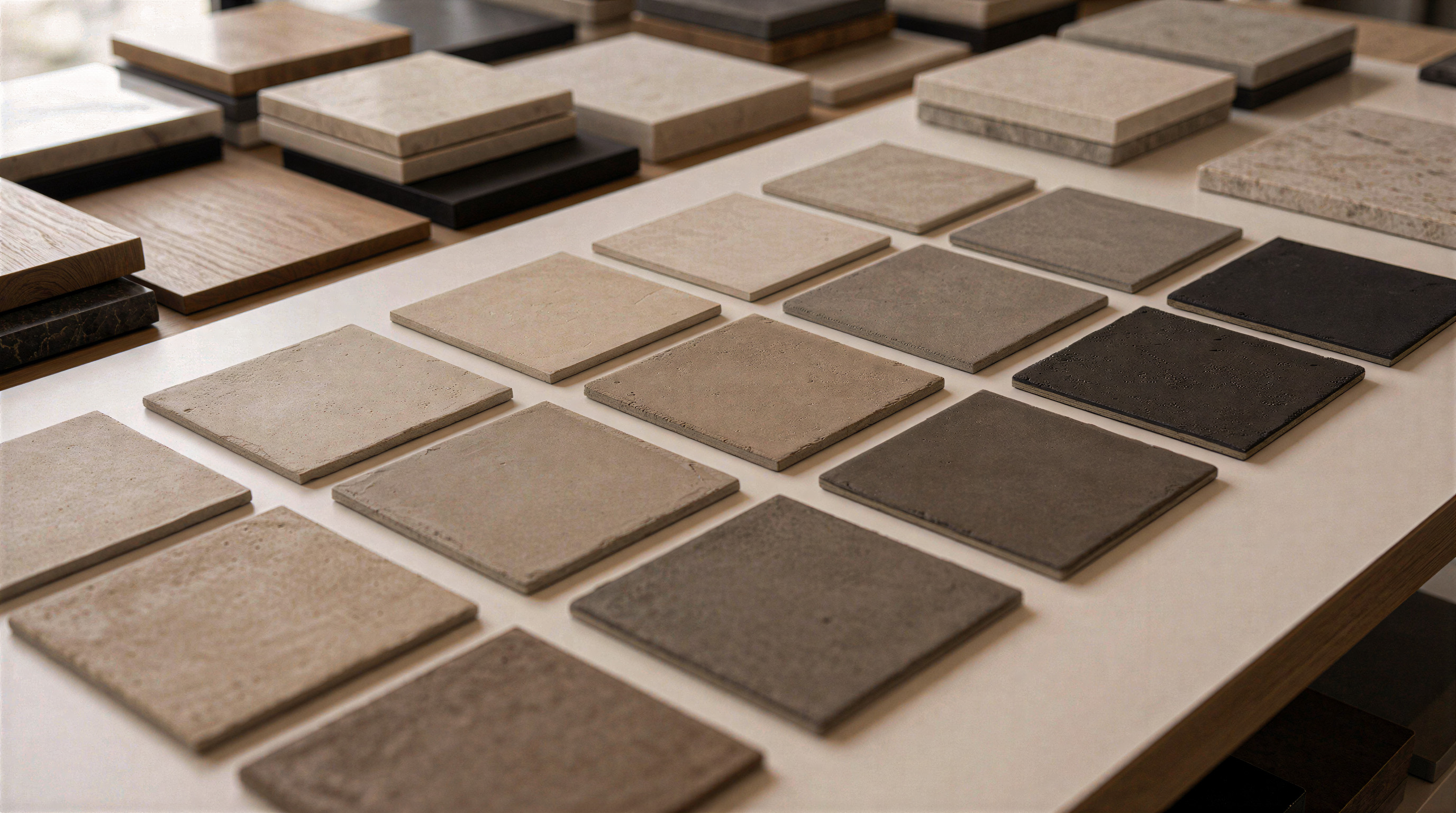
From there, we can discuss which combination feels closest to what you have in mind and explain the reasoning behind our recommendation. The final choice also depends on the proportions of the room: a small sample may feel subtle on the table, but microcement across an entire wall will have a greater presence. We return to the design before settling on the shade, so you can understand how it will contribute to the finished interior.
SEEING MICROCEMENT UNDER DIFFERENT LIGHTING
Light changes the appearance of microcement. A grey that feels warm in daylight may appear cooler under another lighting setting; light directed along a wall can also reveal more of its surface texture.
At the House, the material bar is designed to make those differences visible. Its adjustable lighting temperatures allow us to view the same finish under warmer and cooler light, alongside the other materials proposed for your home. A shade that feels balanced under one setting may reveal an unexpected undertone under another.

During one material selection, a homeowner wanted their living room to feel warmer and more inviting, as the existing interior had long felt too cool. A grey microcement sample sat comfortably beside the chosen timber and stone under warm light, but took on a blue-grey cast under a cooler setting. We compared it with a softer grey with a hint of beige, which held more of the warmth the homeowner wanted. That second shade became the basis for the room’s palette.
Changing the lighting temperature allows you to see those shifts for yourself before the finish is selected. We can then discuss them in relation to the daylight your room receives and the lighting planned for it, so the shade is chosen with the conditions of your home in mind.
HOW MUCH MICROCEMENT TEXTURE DO YOU WANT TO SEE?
Microcement can feel smooth to the touch while showing variation across its surface. Some finishes have gentle shifts in tone; others retain more visible marks from the application.

On a small sample, that movement may be barely perceptible. Across a full wall, it becomes part of the room’s character. A more expressive finish gives the surface greater presence. A quieter one may allow a piece of stone, the shape of a bath or another feature to take the lead.
We look at samples with you up close and from a distance, considering the area the finish will cover and the light that will fall across it. Where microcement is proposed for a bathroom, the selected system and protective finish also need to be appropriate for its location. The visual decision belongs alongside an understanding of how the surface will be used and cared for.
A MICROCEMENT FINISH MADE FOR YOUR HOME
Colour, texture and light may be considered separately during the design process. In the finished room, they are experienced together: the shade beside the materials you chose, the surface seen in daylight and the variations revealed when the lights come on in the evening.
Whether you are renovating a landed home or reimagining your condominium’s interior design, we would love to explore how microcement could become part of the space you have in mind.
Book a private consultation with DreamR.
FREQUENTLY ASKED QUESTIONS
DOES MICROCEMENT CRACK EASILY?
Microcement can be resistant to cracking when properly applied, but cracks may develop if the surface beneath it moves or is improperly prepared. The condition of the existing surface and the installation method both matter. Before application, the installer should assess the substrate and address any cracks or movement so they are less likely to affect the finish.
HOW LONG DOES MICROCEMENT LAST?
Microcement can last for many years when it is properly applied, protected and maintained. Its lifespan depends on the product, the surface beneath it, how the space is used and how well the protective finish is cared for. Your installer can advise when the surface may need attention or its protective coating may need refreshing.
IS MICROCEMENT HIGH MAINTENANCE?
Microcement is generally straightforward to maintain, but it still needs regular cleaning and care. Use cleaning products recommended for the selected finish, and avoid abrasive or acidic cleaners that could damage it. Over time, the protective coating may need to be renewed, depending on the product, the location and how much wear the surface receives.
IS MICROCEMENT REALLY WATERPROOF?
Microcement’s water resistance depends on the specific system and how it is installed and protected. Some products require a suitable sealer, while others are formulated to be waterproof before sealing. In showers and other wet areas, the complete specification, including any required waterproofing beneath the finish, should be confirmed with the manufacturer and installer.
IS MICROCEMENT GOOD FOR BATHROOMS?
Yes, microcement can be used in bathrooms when the selected system is suitable for the intended surface and water exposure. Walls, floors and shower areas may have different requirements for waterproofing, protection and slip resistance. These details should be agreed during design so the finished surface is appropriate for how the bathroom will be used.